
Five Years, 300 Episodes: 5 Parenting Lessons for Raising Tweens and Teens
Sep 23, 2026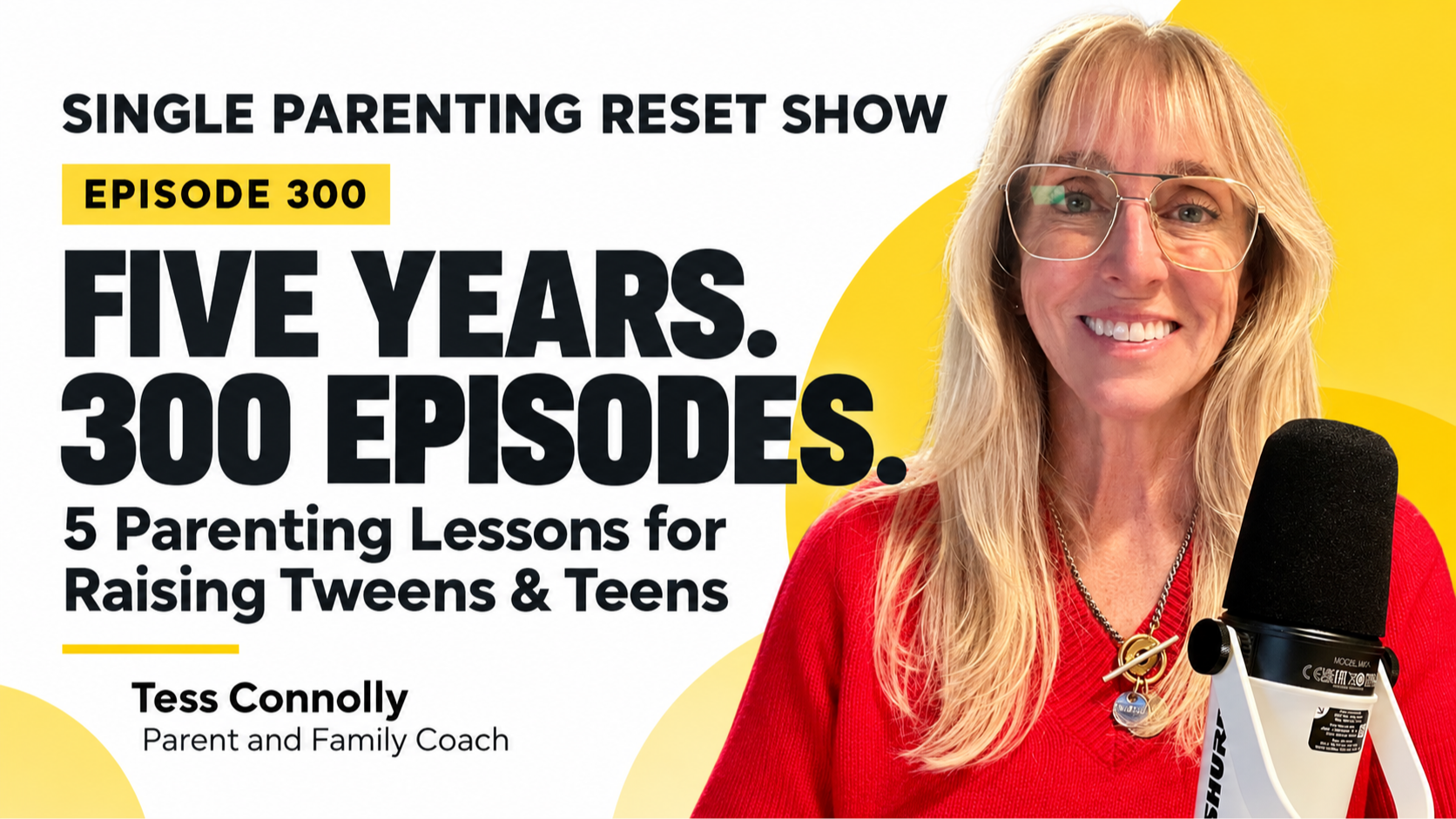
As a parent coach for teens, five years ago, in September 2021, I sat down to record the first episode of my parenting podcast—and I was absolutely terrified.
We were about a year and a half into the pandemic and just beginning to come up for air. My son, Casey, was 12 and entering seventh grade after spending much of sixth grade doing what I called “sofa school”: sitting on the sofa and attending school through a device.
Parenting was much more hands-on then. Casey needed daily guidance and structure, and I was handling most of the day-to-day parenting on my own.
The podcast was originally called The Parenting Reset. I wanted a place to have honest conversations about parenting, develop my own ideas, and grow as a parent alongside the people listening.
Now, five years and 300 episodes later, the show is called the Single Parenting Reset Show. Casey is 17. The format, audience, and focus have evolved, and so have I.
But the central question has stayed remarkably consistent:
How do we guide our children without losing the relationship we have with them?
The Quick Answer
The five most important parenting lessons I have learned as a parent coach for teens are:
- The relationship with your child matters more than the perfect strategy.
- Fear can make loving parents lose sight of the whole child.
- Tweens and teens need us to believe in them—even when they push us away.
- One stable, grounded parent can make an enormous difference.
- Connection, repair, and everyday relationship are powerful interventions.
The encouraging truth beneath all five lessons is that parent-child relationships are not fixed. A parent can begin creating change at any time.
How 300 Podcast Episodes Became a Body of Work as a Parent Coach for Teens
When I began the podcast, my business as a parent coach for teens was still taking shape. I had recently completed an incubator program at The Hivery that helped me move from thinking about what I wanted to create into taking action.
I also had some wonderfully unrealistic expectations. I imagined that within two or three years, the podcast might attract sponsors and begin generating income.
That did not happen as quickly as I thought it would.
What happened first was more important: the podcast became my body of work of my parent coach for teens work.
It gave me a place to develop my voice, articulate what I believed about parenting, learn from guests, and remain accountable to practicing the principles I was teaching.
The second episode was about what I call my family’s “original reset.” In 1976, my parents moved us to the woods of New Hampshire. Their emphasis on cooperation, teamwork, resourcefulness, family, and belonging became foundational to how I parent and how I now work with families.
There were periods when business advisors encouraged me to stop podcasting. The show cost money, growth was slow, and there were more immediately profitable ways to use my time.
I understood the business argument, but I kept returning to the feeling that this work of being a parent coach with teens with a podcast mattered.
When I was 25, I ran the Boston Marathon as a bandit. My father had run Boston before me, and the marathon carried special meaning in our New England family. Training for approximately six months taught my younger, more impulsive self that I could remain committed to something even when the reward was far away.
Podcasting taught me that lesson again on a much larger scale.
The show did not grow overnight. It grew one conversation, one listener, one guest, and one episode at a time.
Lesson 1: The Parent-Child Relationship Matters More Than the Perfect Strategy
When I started the podcast, I already believed connection was important. What I did not fully understand was how deeply the relationship with my son would affect the entire experience of parenting.
A strong relationship does not eliminate disagreement, limits, mistakes, or difficult developmental stages. It gives the family a more secure foundation from which to navigate them.
The greatest satisfaction I feel as a mother does not come from knowing that I handled every interaction perfectly. It comes from the relationship I have with my son.
I have also seen the other side through parents I know and families I have supported. When the relationship with a child is not where a parent wants it to be, it can become one of the deepest forms of parental heartache.
This is not a reason for guilt. It is a reason to treat the relationship as worthy of attention.
Behavior matters. Responsibilities matter. Boundaries matter. But none of these exists separately from the relationship through which we are trying to teach them.
Lesson 2: Fear Can Make a Present-Day Problem Feel Like an Emergency
Many parenting conflicts are intensified by fear.
We fear that our child will not succeed, recover from disappointment, make responsible decisions, develop independence, or learn how to manage adult life.
Once fear takes over, an unfinished assignment, rude response, missed responsibility, or poor choice can begin to represent our child’s entire future.
We react to everything we fear the behavior might mean rather than responding to the actual moment in front of us.
That is when parents often lecture, overexplain, threaten, or try to force an immediate change.
Before responding during conflict, ask yourself:
Am I responding to what is happening right now, or am I reacting to everything I am afraid this could mean about my child’s future?
Pausing does not mean abandoning the boundary. It allows you to separate the current problem from the catastrophic story your fear may be creating.
Lesson 3: Tweens and Teens Still Need Us to Believe in Them
Adolescents are developing identities separate from their parents. They may spend more time with friends, seek greater privacy, challenge our ideas, or communicate—sometimes loudly—that they want us to back away.
They still need us.
Tweens and teens need to know that:
- We believe they are capable.
- We see more than their worst moment.
- We remain emotionally safe when they struggle.
- Our love does not disappear when they disappoint us.
- We trust that they can learn, repair, and grow.
Believing in a teenager does not mean rescuing them from every consequence or approving of every decision. It means communicating:
“I know you are more than this moment. I believe you can find your way, and I am still here.”
That steady belief becomes especially important when our children temporarily lose confidence in themselves.
Lesson 4: A One-Parent Household Is Not a Lesser Family
Single parents often carry an unspoken fear that their family is missing something essential or that they must compensate by becoming two flawless parents.
Your family does not need two perfect parents.
Federal living-arrangement data show that roughly one in four children in the United States lives with one parent. Single-parent families are not a small exception to “real” family life. They are a significant part of American family life.
More importantly, research from the Harvard Center on the Developing Child explains that children who develop resilience despite serious adversity have had at least one stable and committed relationship with a supportive adult.
One consistent, loving, good-enough parent can be powerfully protective.
This does not mean single parenting is easy. It may involve financial stress, emotional exhaustion, loneliness, and the reality that there is not always another adult available to tag in.
It means that family structure alone does not determine the quality of the relationship or the emotional health of the home.
Your family can be whole, loving, and healthy exactly as it is.
Lesson 5: The Relationship Is the Intervention
When I say, “The relationship is the intervention,” I do not mean that connection solves every problem or replaces boundaries.
I mean that our influence comes through the relationship.
Parents naturally fall into a rhythm of reminding, correcting, directing, and setting limits. Eventually, those exchanges can become almost the only conversations we have with our children.
Without intending to, we begin relating to a child as a collection of behaviors to manage instead of as a 12-year-old or 17-year-old person we genuinely want to know.
Relationship-based parenting often begins with very small changes.
Your child wakes up in the morning. Before asking whether the homework is finished or reminding them what must happen before school, you say:
“Good morning. How did you sleep?”
That one question will not transform the entire relationship. But it creates a connection point—and connection points accumulate.
Connection is not permissiveness. It does not require removing expectations or accepting harmful behavior.
It means:
- Relating to the person before addressing the problem
- Regulating yourself before attempting to regulate the interaction
- Maintaining a clear limit without withdrawing love
- Returning later to repair when an interaction goes badly
- Making room for conversations that are not about performance or behavior
The relationship is not a reward children receive after behaving well. It is the foundation that helps our guidance carry influence.
Is It Too Late to Repair Your Relationship With Your Teen?
No.
Whether your child is 10 or 18, the relationship remains capable of change.
The first change will usually need to begin with the parent. Our child is unlikely to enter the room and announce, “I think we need to improve our relationship.”
Parents can make the first move by:
- Responding differently during one familiar conflict
- Becoming curious before correcting
- Acknowledging and repairing something they regret
- Listening without immediately fixing
- Creating one new point of connection
- Maintaining a boundary without using emotional withdrawal
Relationships are not finished products. They are living systems that continually shift in response to what both people bring into them.
One difficult season does not get to write the ending of your relationship.
How Podcasting Changed Me as a Mother
Creating this podcast has made me a better mother because it has asked me to practice what I teach as a parent coach for teens.
Every week—sometimes twice a week—I talk about parenting with connection, steadiness, respect, and repair. Then I return to my own life and try to live those values.
I do not do it perfectly, and I have never wanted the podcast to suggest that I do.
But it has kept me paying attention. It has encouraged me to reset, repair, and continue becoming the parent I want to be.
That may be the most meaningful thing these 300 episodes have given me.
A Simple Reset to Try Today
Before your next reminder, correction, or command, offer one genuine connection point.
You might say:
- “How did you sleep?”
- “What was the best part of your day?”
- “Do you want company or some space?”
- “I can see this has been a lot.”
- “I love you. We can work through this.”
You do not have to fix the entire relationship today.
Create one moment in which your child feels known rather than managed.
Then begin again tomorrow.
Frequently Asked Questions
What do tweens and teens need most from their parents?
Tweens and teens need parents who believe in their capacity, provide emotional safety, maintain appropriate boundaries, and remain available even when the child seeks greater independence or pushes the parent away.
Does connection-based parenting mean being permissive?
No. Connection-based parenting allows parents to maintain expectations and limits without threatening the parent-child relationship. A parent can validate a child’s feelings while still saying no or holding a boundary.
Can a single parent provide enough stability for a child?
Yes. A one-parent household is not inherently a lesser family. Research on resilience emphasizes the protective importance of at least one stable, committed, supportive adult relationship. Single parents also deserve practical and emotional support; “one parent can matter enormously” does not mean one parent should have to manage everything alone.
How can I reconnect with a teenager who has pulled away?
Begin with small, low-pressure interactions. Listen without immediately correcting, show interest in what matters to your teen, repair past interactions when appropriate, and create moments of connection that are not attached to demands.
What does “the relationship is the intervention” mean?
It means that trust, emotional safety, connection, and repair are not extras added after the parenting strategy. They are the relational conditions that allow guidance, boundaries, and problem-solving to be effective.
Is it too late to repair my relationship with my teen?
No. Relationships remain capable of change. Parents can initiate change by regulating their responses, becoming curious, taking responsibility for their part, and consistently creating new experiences of connection.
Final Thought
Episode 300 is not a story about doing something perfectly. It is a story about continuing—one episode, one conversation, and one reset at a time.
You do not need to get every parenting moment right.
Keep returning to the relationship.
Because the relationship is the intervention.
If conflict has been taking over your relationship with your tween or teen, download my free Tween and Teen Conflict Reset Kit. It includes seven practical scripts and a First-Ten-Minutes Plan to help you lower the temperature and reconnect.
Join the Family here...
We hate SPAM. We will never sell your information, for any reason.